


How Acupuncture Works: Benefits, Uses & What to Expect
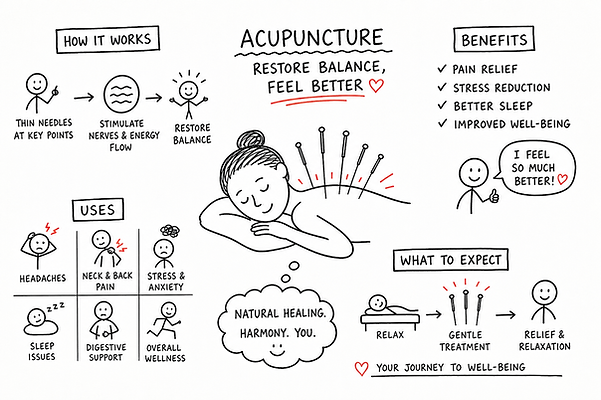
In our Sunnyvale 𝐇𝐨𝐩𝐞𝐰𝐞𝐥𝐥 𝐌𝐞𝐝𝐢𝐜𝐚𝐥 𝐀𝐜𝐮𝐩𝐮𝐧𝐜𝐭𝐮𝐫𝐞 𝐂𝐞𝐧𝐭𝐞𝐫 most people walking into their first acupuncture appointment arrive with two things: a health problem they haven't been able to solve and a vague sense of unease about what the needles will actually feel like. That combination of curiosity and uncertainty is completely normal, and, based on what practitioners hear consistently during patient intakes, remarkably common. This therapy has been practiced for over 2,500 years and is now used in hospitals, pain clinics, and integrative health centers across the United States,
yet for many people it still feels like unfamiliar territory.
This guide is designed to change that. Whether you're dealing with chronic back pain, recurring migraines,
hormonal imbalances, or persistent stress, clear and honest information is the best starting point. The
questions first-time patients ask are almost always the same: What actually happens? Does the science
support it? Is it safe? This article answers all of that. We'll cover how the therapy works, the main types of
needle treatment available, what conditions it addresses, what your first session looks like, safety
considerations, and how to find a practitioner you can trust.
What acupuncture actually is: the TCM framework in plain language
The ancient system behind the needles
Traditional Chinese medicine (TCM) is the foundation on which this practice was built. In TCM theory, the
body contains a vital energy called Qi (pronounced "chee") that flows through a network of pathways
called meridians. When that flow is balanced and unobstructed, the body functions well. When it's
disrupted, by stress, injury, poor sleep, or emotional strain, illness and pain follow. Needles are placed at
specific points along these meridians to restore balance and support the body's natural healing capacity.
This framework has guided clinical practice across Asia for more than two millennia and still informs how
skilled TCM practitioners assess and treat patients today.
How Western science explains the mechanism
Modern biomedical research offers a complementary lens. When a needle is inserted and manipulated, it
activates mechanoreceptors and sensory nerve fibers in the skin, fascia, and muscle. Those signals travel
to the spinal cord and brain, where they trigger the release of endorphins, adenosine, and other
neurotransmitters involved in pain regulation. Studies also indicate modulation of the autonomic nervous
system, including a shift toward parasympathetic (rest-and-repair) activity and changes in serotonin and
dopamine pathways; these findings are supported by neurophysiological research on autonomic
modulation. Some anatomical mapping research suggests that needle points frequently correspond to
areas of dense nerve endings and connective tissue, which may help explain why placement at specific
locations can produce consistent physiological responses. Both frameworks, TCM and Western
biomedicine, describe real phenomena, and understanding both gives you a fuller picture of what this
therapy actually does.
The types of treatment you might encounter
Traditional needling vs. electroacupuncture
Traditional treatment involves placing thin, sterile needles at specific points, with the practitioner using
manual manipulation to stimulate the needle and generate the therapeutic response. Electroacupuncture
follows the same needle placement but adds small electrical pulses delivered through the needles,
amplifying the stimulation and extending its reach into surrounding tissue. This electrically enhanced
method is often preferred for persistent pain, muscle spasm, and conditions that require a stronger
therapeutic signal. In studies comparing the two approaches for myofascial pain, electroacupuncture,
particularly motor-point variants, has shown greater pain relief than manual needling alone, based on
trials examining trapezius myofascial pain specifically.
Dry needling and how it differs
Dry needling uses the same filiform needles but operates from a completely different theoretical
foundation. Instead of treating meridian-based imbalances, dry needling targets myofascial trigger points
and taut muscle bands, guided by Western anatomy and musculoskeletal assessment rather than TCM
point maps. The goal is to provoke a local twitch response in the muscle, release tension, and restore
movement. There is meaningful overlap between the two approaches for certain pain conditions, but the
clinical framework and practitioner training pathway are distinct. These methods are not interchangeable,
and it's worth asking any practitioner which one they use and why it suits your specific presentation.
What conditions it treats and what the evidence says
Strongest evidence: chronic pain, migraine, and musculoskeletal issues
The most robust evidence centers on chronic pain. A large individual-patient-data meta-analysis by the
Acupuncture Trialists' Collaboration found needle therapy superior to both sham and no-treatment
controls across back and neck pain, osteoarthritis, chronic headache, and shoulder pain. Subsequent
syntheses and updates through 2022 build on that work and refine effect estimates; see the updated
review and meta-analysis for a more recent summary. The effect sizes are real, though the difference
compared to sham treatment is modest, which suggests that both specific needle effects and nonspecific
contextual factors contribute to the outcome. For migraine prevention, some clinical guidelines,
including recommendations from NICE and the American Academy of Neurology, recognize needle
therapy as a non-pharmacological option for patients who want to reduce reliance on medication. The
evidence base is strongest for musculoskeletal pain and chronic headache, and practitioners and
patients should approach other conditions with that context in mind.
What are the benefits and risks of acupuncture?
For conditions where the evidence is still developing, clinical outcome reports are encouraging but mixed
in quality. Stress and anxiety, sleep disruption, hormonal imbalance, PCOS, and fertility support are among
the most common reasons people seek TCM-focused care. The therapy's documented effect on the
autonomic nervous system, specifically its ability to reduce sympathetic (fight-or-flight) activity, provides a
physiological rationale for stress-related applications. For reproductive health, TCM explanatory theory
describes treatment as addressing underlying patterns in hormone regulation and blood flow to
reproductive organs, though the clinical research in this area ranges from preliminary to moderately
supportive and does not yet match the strength of the pain evidence. This whole-body, root-cause
orientation is one of the clearest distinctions between TCM-based treatment and conventional symptom
management, and it's a distinction worth discussing openly with your practitioner.
What to expect at your first acupuncture session: intake to aftercare
The intake process and needle insertion experience
A first appointment begins with a comprehensive health intake. Your practitioner will ask about your
primary concerns and also about sleep quality, digestion, stress levels, menstrual health if relevant, and
your full medical history. This wide-angle assessment reflects TCM's systems-based view of health and
helps the practitioner identify patterns rather than isolated symptoms. Needle insertion itself is far gentler
than most people expect. Patients typically feel a brief pinch at the surface, followed by sensations of
warmth, heaviness, tingling, or a dull spreading ache around the needle site. These sensations are normal
and indicate the needle is engaging the target point. Most patients feel deeply relaxed within the first few
minutes; falling asleep on the table is genuinely common.
How many sessions to expect and what recovery looks like
This therapy is not a single-session fix, and setting realistic expectations from the start makes the
process far less frustrating. Most courses begin with one to two sessions per week, and a typical initial
treatment plan runs six to twelve sessions before formally assessing progress. Acute conditions may be
treated more intensively at first, sometimes two to three times per week for the first few weeks, while
chronic or complex conditions often require a longer course of care. After a session, mild soreness or
fatigue at needle sites is common and typically resolves within a day. Some patients notice a meaningful
shift after just one or two appointments; others experience gradual, cumulative improvement across
several weeks of consistent treatment.
Safety profile: what you need to know about risks and side effects
Common minor side effects and what's normal
This is considered a low-risk therapy when performed by a licensed practitioner using sterile, single-use
needles. Minor side effects include brief needling discomfort during insertion, small bruises or
hematomas at needle sites, temporary dizziness, and short-lived fatigue. Safety studies report minor
adverse events in roughly 7 to 14 percent of treatments depending on the study population, and the large
majority of these are self-resolving within a day. The German PEP-Ac study, one of the largest prospective
acupuncture safety studies conducted, found that only 0.003 percent of treatments resulted in a severe
adverse event. By comparison, commonly used oral analgesics carry their own documented adverse
event profiles, which makes the overall risk level here relatively low for most patients. For a broader look
at reported adverse events and safety considerations across many studies, see the systematic review of
acupuncture-related adverse events.
Serious complications and who should be cautious
Serious complications are rare and almost always linked to improper technique or non-sterile equipment.
Pneumothorax, a collapsed lung caused by a misdirected needle near the chest wall, is the most cited
serious complication in safety literature. Large-scale safety reviews report it in only a handful of cases per
millions of treatments. People who are pregnant, have implanted pacemakers, take anticoagulant
medications, or have active skin infections in proposed treatment areas should disclose this during their
intake appointment. A qualified, licensed practitioner screens for all of these factors before beginning
treatment, and adjusting the plan to account for contraindications is standard clinical practice.
How to find a qualified acupuncturist you can trust
Credentials and licensing requirements in the United States
The practice is regulated at the state level in the U.S., and the training pathway for non-physician
acupuncturists is substantial. A licensed acupuncturist typically completes a three-to-four-year accredited
graduate program, passes NCCAOM national board examinations covering theory, point location,
biomedicine, and in many cases Chinese herbology, and then obtains a state license. In California,
practitioners must pass the California Acupuncture Licensing Examination administered by the California
Acupuncture Board, which requires a minimum of 3,000 hours of theoretical and clinical training. When
choosing a practitioner, verify their state license, ask about their years of clinical experience, and confirm
whether they have specialty training relevant to your specific needs, such as reproductive health, pain
management, or nervous system regulation.
Why where you go matters: Hopewell Medical Acupuncture Center
For Silicon Valley residents, Hopewell Medical Acupuncture Center in Sunnyvale combines thorough TCM
training with a medically informed, root-cause treatment philosophy. Every treatment plan starts with a
detailed intake, is tailored to the individual, and is adjusted based on how your body responds over time.
The clinic works with patients across a broad range of concerns, from chronic pain and stress to
hormonal health and fertility support, and practitioners take the time to explain what they're doing and
why. Choosing a clinic with verifiable credentials, transparent intake processes, and clear specialty
experience is one of the most important decisions you'll make when starting care. If you're ready to have
that conversation, you can book a consultation at Hopewell Medical Acupuncture Center to discuss your
health goals directly.
The bottom line on acupuncture
Needle therapy is a time-tested practice with a real evidence base for chronic pain, migraine prevention,
and several other conditions. Its safety profile, when delivered by a licensed practitioner, is welldocumented
and favorable compared to many conventional treatment options. Most first-time patients
find the experience more comfortable than they anticipated and leave their first session feeling noticeably
calmer. The key to getting results is choosing a qualified practitioner with the right training for your
specific health goals and committing to an initial course of treatment rather than expecting a single
session to resolve a long-standing condition.
This therapy works best as a root-cause intervention, not a temporary patch. If you're exploring it as a
standalone approach or as part of an integrative care plan alongside your primary physician, the practical
next step is the same: find a practitioner with verified credentials and have an honest conversation about
your health goals. If you're in the Sunnyvale area, the team at Hopewell Medical Acupuncture Center is
available for consultations. Book an appointment, ask your questions, and get a clear picture of whether
this approach fits your care plan.